
Roller Blinds
Sunscreen where the vineyard view is the whole point, blockout where a guest suite needs real dark — made to measure for cellar-door glass and homestead sash windows alike.
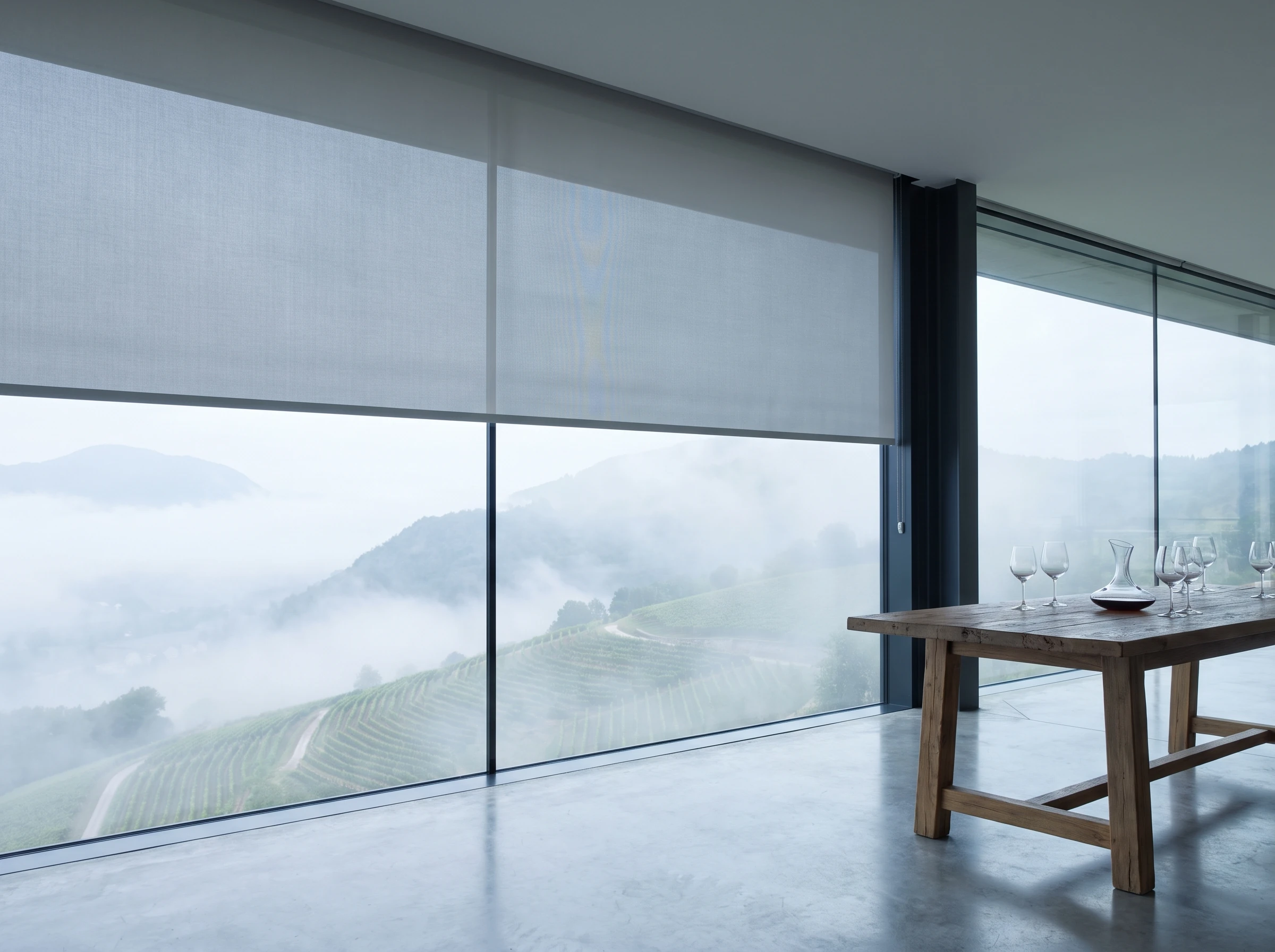
Two fabrics, two jobs
Sunscreen fabric, in 3%, 5% or 10% openness, cuts glare and UV while keeping the vineyard visible through the weave — the lower the percentage, the more heat and glare it stops, at the cost of a little view. A 3–5% weave is the standard choice for the wide glass most cellar-door and tasting-room extensions are built around, because that glass exists specifically to hold the view.
Blockout fabric does the opposite job: total dark for a guest-suite bedroom, a farm office presentation, or a cellar workspace, plus a genuine insulating layer against the swing between a hot Winelands afternoon and a cool evening. It's the fabric to reach for anywhere the goal is "no light at all," not "less light."
02Double roller, one bracket
Guest cottages built for overnight visitors often end up running a double roller — blockout for night, sunscreen for the rest of the day, on the same headrail. It's the practical middle ground between wanting daylight over the vines and wanting an actual dark room for a guest who's driven a long way to be there.
03Control options
Chain control with a wall-anchored tensioner as standard, spring-assist for a lighter action, or fully motorised for wide cellar-door glass or a run of linked tasting-room panels — see our motorised automation range for multi-blind setups.
- Suits both shallow homestead sash openings and wide modern cellar-door glass
- Fabric range runs from entry weaves through to premium sunscreen fabrics
- Cassette or pelmet valances hide the tube, fascia colour-matched to your frames
One honest limit
Very wide spans — beyond roughly 3m of unbroken fabric — need either a central join line or a second, linked blind. On the homestead's original sash windows, a timber or aluminium venetian sometimes suits the shallow reveal better than a roller.
What a roller blind costs out here
Rollers are quoted per square metre, installed. A manual blind on a chain or a spring, in sunscreen, blockout or a light-filtering weave, runs R1,000 to R1,600 the square metre; a double roller with two fabrics on one bracket sits near the top of that. Motorised, the same opening comes to R2,500 to R3,800, which covers the tube motor, the control and the commissioning.
A small opening is charged at a minimum rather than by area, because the tube, brackets and the trip out to the farm cost the same on a narrow pane as on a wide one. And a band is not a quotation: your own per-window figures come out of the free measure and are put in writing before anything is cut.
From Banghoek's misty cellar doors to Bottelary's sun-baked farmland, sunscreen and blockout rollers are the everyday answer on almost every pane of glass we measure along the route.
Get your windows measured
Free in-home measure, a full written quote, no obligation.
Book your free measure